



The Ministry of Science, Education and Youth has launched the Call for Grants for the Proof of Innovative Concept – First Call (reference number PK 1.1.17). The Call is open from 15 May 2026 to 15 September 2026, with project proposals accepted from 11:00 a.m. on 16 June 2026. The total funding available is EUR 5,304,291.67.
Objective of the Call
The objective is to increase readiness for the development of new products and processes through enhanced R&D and innovation capacities of enterprises and research organisations. The Call supports the implementation of R&D activities aimed at developing or further improving solutions and technical validation prior to the commercialisation phase, in order to determine commercialisation potential, guide further development, and reduce investment risk.
Specific objectives of the Call:
- improving the market readiness of research and development results
- enhancing the capacities of enterprises for research, development and innovation
Eligible Applicants
The following can apply:
- micro, small and medium-sized enterprises (SMEs) as defined in Annex I of Regulation (EU) No 651/2014
- research organisations as defined in the Framework for State Aid for Research and Development and Innovation (2022/C 414/01) — universities, research institutes, technology transfer agencies, innovation intermediaries, and virtual research-oriented collaborative entities
Who cannot apply:
- natural persons
- large enterprises
- associations and charitable organisations
- flat-rate trades (lump-sum sole proprietorships)
- undertakings in difficulty within the meaning of Article 2(18) of Regulation 651/2014
- applicants (enterprises) with no employees in the year preceding the year of submission
Key conditions:
- the project is implemented on the territory of the Republic of Croatia
- partnerships are not permitted under this Call — the project is carried out independently
- each applicant may submit a maximum of two (2) project proposals
- activities must fit into one or more thematic priority areas of the Smart Specialisation Strategy until 2029
S3 thematic priority areas:
- Personalised healthcare
- Smart and clean energy
- Smart and green transport
- Security and dual-use — awareness, prevention, response and remediation
- Sustainable and circular food
- Customised and integrated wood-based products
- Digital products and platforms
Amounts and Aid Intensity
- minimum grant per project: EUR 26,500
- maximum grant per project: EUR 70,000
- total allocation for enterprises: EUR 3,713,004.17
- total allocation for research organisations: EUR 1,591,287.50
Aid intensity for research organisations — the award does not constitute State aid and may reach up to 100% of the project’s eligible costs.
Aid intensity for enterprises (SMEs):
- aid for research and development projects (Art. 25 of Regulation 651/2014):
- micro and small enterprises — 70%
- medium-sized enterprises — 60%
- aid for innovation for SMEs (Art. 28 of Regulation 651/2014):
- micro, small and medium-sized enterprises — 50%
The applicant must cover the difference up to the full project value from its own funds or other sources that do not constitute Union funds. VAT on eligible costs that the applicant is not entitled to recover is considered an eligible cost.
Eligible Activities
All of the following activities are mandatory for each project:
- Research (TRL 3-4) — prototype development and/or demonstration of technical feasibility
- Business validation activities — market analysis, feasibility study, development of a concept and/or strategy for the development and/or commercialisation of the product, verification and protection of intellectual property, patent searches, validation of the idea and market need
- Project management — reporting, preparation of reimbursement claims, preparation and conduct of (public) procurement procedures
- Project promotion and visibility — website development, design and printing of promotional materials, billboards or posters, organisation of project promotion events
- Implementation of horizontal activities — non-discrimination, gender equality, integration of persons with disabilities, promotion of fundamental rights and sustainable development goals
The project will primarily finance activities at technology readiness level TRL 3-4 (industrial research), including digital technologies such as supercomputing, quantum technologies, blockchain, artificial intelligence, cybersecurity, big data and cloud computing.
Technology Readiness Levels
The TRL framework is a measurement system in which each level describes a stage in the development of a technology. Using the TRL method enables a standardised understanding of technical maturity across different types of technology. The TRL system applies to all types of research, regardless of whether the innovation concerns a product or a service. There are 9 technology readiness levels: TRL 1 is the lowest, while TRL 9 is the highest, most mature technology.
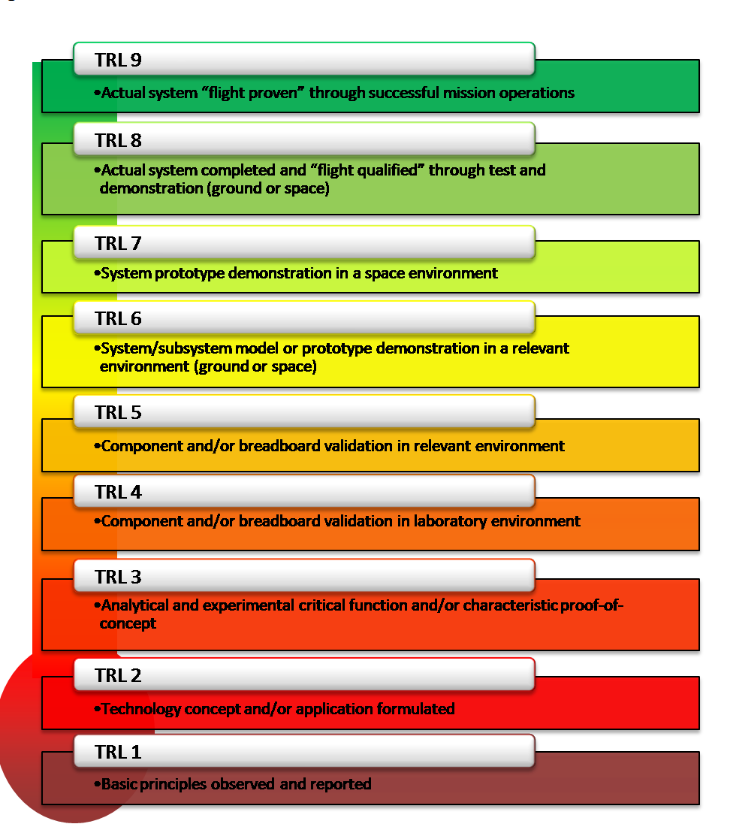
Table 1. Technology Readiness Levels
Eligible Costs
For enterprises (SMEs):
- personnel costs (standard scale of unit costs — gross hourly rate for existing and newly hired employees)
- costs of external research services
- depreciation costs of instruments and equipment used for the project
- costs of materials and small inventory
- costs of external services for business validation, market analysis, feasibility study, commercialisation study or plan, and IP protection — up to 15% of eligible project costs
- other expenses arising from project implementation (project management, visibility, indirect costs, per diems, accommodation, travel, dissemination) — up to 20% of eligible costs
For research organisations:
- personnel costs (standard scale of unit costs)
- costs of external research services
- costs of external services for business validation and IP protection — up to 15% of eligible project costs
- costs of purchasing R&D equipment, including IT equipment and software (with mandatory verification of equipment availability in Croatia via the CroRIS system)
- costs of materials and small inventory
- costs of dissemination of research results — up to 10% of eligible costs
- external expert services for preparing and conducting procurement and project administration — up to 15% of eligible costs
- project promotion and visibility costs — up to 10% of eligible costs
- costs related to the implementation of horizontal principles
- indirect costs — flat rate of up to 15% of eligible direct personnel costs
Ineligible Costs
- recoverable (deductible) VAT
- interest and other financial charges
- fines, financial penalties, and legal costs
- purchase or lease of land and real estate
- construction of buildings and infrastructure
- purchase or acquisition of motor vehicles
- costs of advertising, sale and/or distribution of products or services
- investments in strengthening the applicant’s production or sales capacity
- depreciation costs of assets whose acquisition was supported by public funds
- costs already funded by other national or EU programmes
- any profit distributions, including dividends
Application Procedure
Project proposals are submitted exclusively electronically via the eKohezija portal (https://ekohezija.gov.hr). The award procedure is conducted as an open procedure in temporary call mode.
- opening of the Call: 11:00 a.m. on 15 May 2026
- start of receipt of applications: 11:00 a.m. on 16 June 2026
- final application deadline: 11:00 a.m. on 15 September 2026
- award procedure: up to 120 calendar days from the expiry of the deadline for submitting proposals
The competent body (Intermediate Body Level 1) is the Ministry of Science, Education and Youth, and the implementing body (Intermediate Body Level 2) is HAMAG-BICRO.
Evaluation
Project proposals are evaluated against seven criteria — totalling up to 100 points:
- Value for money offered by the project (0–20)
- Financial sustainability of the project (0–15)
- Implementation capacity (0–15)
- Design and maturity (0–15)
- Promotion of equal opportunities and social inclusion (0–3)
- Promotion of sustainable development and contribution to the green transition (0–2)
- Innovativeness (0–30)
A positive quality evaluation requires at least 70 points across all selection criteria, with a minimum number of points required for each individual criterion.
